
This #Church Square tagged image is courtesy of Flickr. Click on the Flickr account holder below the photograph to see more.
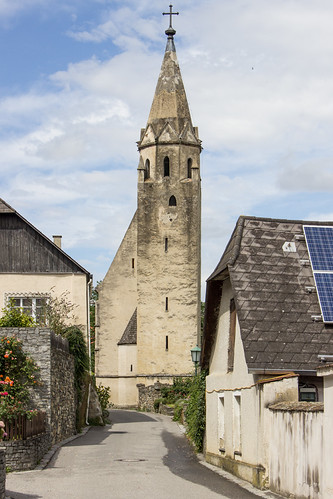
Image by Billy Wilson Photography
"The church of Schwallenbach goes back to a chapel from 1420, which was consecrated to Saint Sigismund. Buttresses and vaulted ribs indicate the late Gothic style. A statue of the Virgin Mary in the church has been preserved from 1515, the baroque altar was consecrated in 1724 by the bishop from Passau. The altarpiece by Martin Johann Schmidt, dedicated to Saint Sigismund, dates from 1767.
Schwallenbach is located on the left bank of the Danube between Willendorf in der Wachau and Spitz.
Schwallenbach was first mentioned in a document as early as 830, when it came as a gift from Charlemagne to the Bavarian Niederaltaich monastery. In 1443 a judge and council of the now fortified market was named. In 1463 the Bohemians devastated the place, furthermore the chapel was adapted to a single-nave church. In 1504 the area finally passed into the possession of the Habsburgs. As 1620 Imperial troops during the Thirty Years War from entering the site, there is widespread destruction. The church tower burned down and received its stone helmet. In 1645 the place finally suffered from the destruction by the Swedes.
Diagonally opposite the church is the little bell of Schwallenbach, a medieval castle that was originally the seat of the Schwallenbachers. Engelschalcus and Chunradus de Swelpach are first mentioned here in 1243. After being destroyed several times, the seat now presents itself as an irregular two-storey four-wing building and its appearance goes back to the renovation by Anna von Polheim in 1617. The still preserved medieval, square, five-storey defense tower is remarkable.
The Rannahof house belonged to the Ranshof estate as a reading yard and later served as a monastery. Other houses from the 15th and 16th centuries have been preserved, including the old rectory.
The Wachau (German pronunciation: [va?xa?]) is an Austrian valley with a picturesque landscape formed by the Danube river. It is one of the most prominent tourist destinations of Lower Austria, located midway between the towns of Melk and Krems that also attracts "connoisseurs and epicureans" for its high-quality wines. It is 36 kilometres (22 mi) in length and was already settled in prehistoric times. A well-known place and tourist attraction is Dürnstein, where King Richard the Lionhearted of England was held captive by Duke Leopold V. The architectural elegance of its ancient monasteries (Melk Abbey and Göttweig Abbey), castles and ruins combined with the urban architecture of its towns and villages, and the cultivation of vines as an important agricultural produce are the dominant features of the valley.
The Wachau was inscribed as "Wachau Cultural Landscape" in the UNESCO List of World Heritage Sites in recognition of its architectural and agricultural history, in December 2000." – info from Wikipedia.
Summer 2019 I did a solo cycling tour across Europe through 12 countries over the course of 3 months. I began my adventure in Edinburgh, Scotland and finished in Florence, Italy cycling 8,816 km. During my trip I took 47,000 photos.
Now on Instagram.
Become a patron to my photography on Patreon.
This Church Square image was automatically curated and published with WP Robot plugin – CLICK HERE to learn more about WP Robot for WordPress – a massive time and money saver.
