
This #Blue Bulls tagged image is courtesy of Flickr. Click on the Flickr account holder below the photograph to see more.
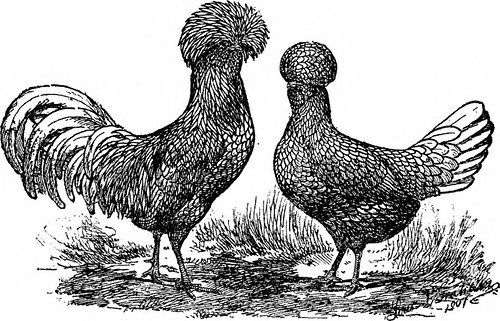
Image by Internet Archive Book Images
Identifier: CAT88204158
Title: Standard varieties of chickens
Year: 1907 (1900s)
Authors: Howard, George E.
Subjects: Chicken breeds
Publisher: Washington : U.S. Dept. of Agriculture
View Book Page: Book Viewer
About This Book: Catalog Entry
View All Images: All Images From Book
Click here to view book online to see this illustration in context in a browseable online version of this book.
Text Appearing Before Image:
rrow band of black feathers at the base of the crest in front isallowable, but the fewer the better. The shanks and toes are blue ordark leaden blue; comb and wattles are bright red, and ear lobes arewhite. The Golden and Silver varieties are beautifully marked in plumage.In the Golden the feathers are marked with rich golden bay and lacedwith black. The feathers of the Silver are silvery white, instead ofthe golden bay, and are laced with black. The illustration (fig. 16)shows the general markings of the feathers. The White Polish ispure white throughout the plumage. The feathers of the Buff Lacedshould be of a rich buff color with a narrow white lacing. There are two distinct subbreeds of Polish, the plain (nonbearded)and the bearded. The latter has a thick, full beard, running back ofsi 33 the eye in a handsome curve, and in color corresponding with thebalance of the plumage. The eight varieties of Polish are: White-crested Black, Bearded Golden, Bearded Silver, Bearded White, Bull
Text Appearing After Image:
Fig. 16.—Pair of Bearded Silver Polish. Laced, Nonbearded Golden, Nonbearded Silver, and NonbeardedWhite. No standard weight is given for Polish; they are of medium size,about that of Leghorns. CLASS VI—DUTCH.HAMBURGS. Hamburgs (fig. 17) are in the front rank of egg producers. Thereare six varieties of this breed: The Golden-spangled, Silver-spangled.Golden-penciled, Silver-penciled, Black, and White. They are allvery pretty birds, and seldom fail to prove attractive and profitableto the average breeder and fancier. Hamburgs are economical fowlsto keep; besides being light eaters and great foragers, they are pro-lific layers and nonsitters. The only thing against them is thesmallness of their eggs. They lay a pretty, white-shelled egg, butsmaller in size than those of the Leghorn. There are some whichlay larger eggs than others, and by careful selection from year toyear of the birds which lay the largest eggs this defect may be reme-died and the size of the eggs improved. The Silv
Note About Images
Please note that these images are extracted from scanned page images that may have been digitally enhanced for readability – coloration and appearance of these illustrations may not perfectly resemble the original work.
This Blue Bulls image was automatically curated and published with WP Robot plugin – CLICK HERE to learn more about WP Robot for WordPress – a massive time and money saver.

