
Sean Hoatson, the CEO of Normandien Farms, said the group has laid criminal charges against members of parliament (MPs) for crimen injuria and racist behaviour.
This followed an unannounced visit by the MPs, accompanied by armed police officers, to Normandien Farms last month.
On 4 February 2026, the Department of Employment and Labour released a statement saying it was a joint inter-department team visit to the farm.
It said the visit included people from the Inspection and Enforcement Services and the Portfolio Committee on Employment and Labour.
And that is where it gets messy as the farm says that the ‘raid’ was highly intimidating and smelled like a witch hunt – sentiments shared by one of the Parliamentarians who was present at the raid – Patriotic Alliance MP Juliet Basson.
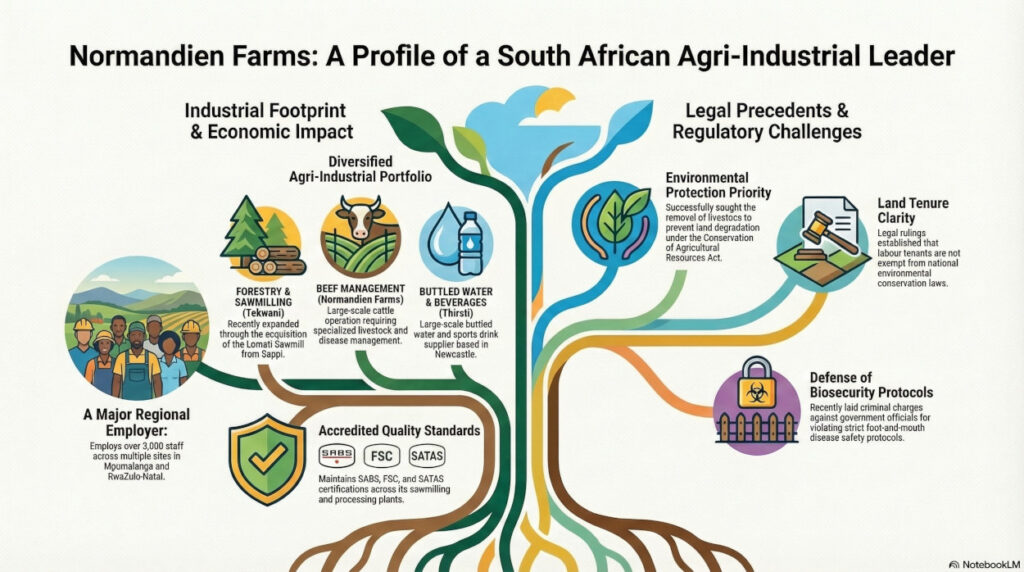
Normandien Farms (Pty) Ltd is a major South African agricultural enterprise involved in beef farming, timber processing, and water bottling. The company has faced various legal and operational challenges, including a complex dispute with labour tenants regarding overgrazing and land rights.
High-level court documents detail litigation over land acquisition claims and the enforcement of environmental regulations under the Conservation of Agricultural Resources Act.
Furthermore, the company has engaged in constitutional challenges involving government departments and has recently filed criminal charges against Members of Parliament following this recent controversial and allegedly racist site inspection.
The 16 online sources that we examined collectively illustrate a business navigating fraught industrial relations and significant regulatory and political pressures within the South African landscape.
Synopsis – Normandien – A Farm Under Siege
BizNews Coverage:
BizNews are doing a sterling job highlighting the concerns of Normandien Farms and one Parliamentarian over the recent ‘hostile raid’ of the farm by Parliamentary Oversight Committee Members.
Director’s Cut: Normandien Farms CEO Hoatson weighs in on parliamentary raid debacle
Parliamentary “raid” on Newcastle employer sparks outrage over abuse of power and investor fears
Right of Reply: Patriotic Alliance MP speaks out on chaotic Normandien Farms oversight visit
Five Surprising Realities Behind the Normandien Farms Saga
The quiet efficiency of Normandien Farms, a massive economic anchor in the Newcastle district of KwaZulu-Natal, was not shattered by market volatility or the region’s industrial decline. Instead, on February 4, 2026, it was punctured by a convoy of ten SUVs carrying fifty unidentified individuals. What followed was a confrontation that weaponized political oversight against the rigid, clinical requirements of modern agriculture.
For a farm that manages thousands of cattle and employs over 3,000 people, the arrival of this unannounced “oversight visit” felt less like a government inspection and more like a farm invasion.
The 2026 “Raid”: When Oversight Turns Into an Invasion
The clash at the gates of Normandien Farms highlighted a dangerous disconnect between parliamentary theater and agricultural reality. While the Portfolio Committee on Employment and Labour framed their visit as a standard check on departmental operations, the ground-level experience was chaotic. Security was overrun; the pedestrian gate was swarmed, and the vehicle gate was forced open by individuals accompanied by heavily armed police.
This was not merely a breach of private property but a potentially catastrophic violation of biosecurity. South Africa’s agricultural sector currently teeters on the edge of a foot-and-mouth disease crisis. CEO Sean Hoatson reported that the convoy ignored all sterilization protocols—essential for anyone entering a high-risk livestock area. The visit, which Hoatson characterized as a “hostile, unauthorized inspection” designed for “social media likes,” allegedly involved verbal abuse and racist remarks directed at senior staff.
Even within the delegation, the optics were deemed excessive. MP Juliet Basson later expressed deep professional embarrassment over the conduct of her colleagues.
“I am extremely embarrassed about what happened at Normandien Farms… when I saw the gate being broken open I knew this is not normal… my heart broke for what happened there.” — Juliet Basson, Member of Parliament.
Despite the farm’s spotless compliance record, the raid resulted in a prohibition notice regarding dust masks—a finding Hoatson dismissed as a performance for the cameras.
The Legal “Loophole”: Why Removing Cattle Isn’t Always an Eviction
A landmark Supreme Court of Appeal (SCA) judgment (Minister of Rural Development and Land Reform v Normandien Farms) provided the technical “teeth” that continue to define land-use rights in South Africa. The core question: Does a court-ordered removal of livestock due to overgrazing constitute an “eviction” under the Land Reform (Labour Tenants) Act (LTA)?
The SCA’s answer was a definitive no. The court established that labour tenants are not exempt from the Conservation of Agricultural Resources Act (CARA). The judgment prioritized the environmental integrity of the soil over the traditional grazing rights of occupiers. Because the land was being devastated by overstocking, the court ruled that removing the animals to protect the vegetation was a mandate of CARA, not a repudiation of residency rights.
Remarkably, the court departed from the “Biowatch principle”—the constitutional standard where the state usually bears costs in public interest litigation. In a rare move that underscored the court’s displeasure with the occupants’ conduct, they were ordered to pay punitive costs in the lower court.
An Economic Juggernaut: From Sawlogs to Sports Drinks
There is a biting irony in the scale of the Normandien operation. Managed under the Tekwani Group, this is an agri-industrial empire with a history stretching back to 1992. The group recently expanded its footprint by acquiring Sappi’s Lomati Sawmill in Mpumalanga—a facility with a staggering annual capacity of 86,000 m³ of pine lumber. Beyond timber, the group owns “Thirsti,” a dominant brand in the national bottled water and sports drink market.
Yet, for all its multi-million-rand corporate scale, the enterprise remains governed by the grit of the Newcastle soil. A recent job posting for a “Junior Beef Farm Manager” at the site perfectly encapsulates this contrast. The candidate required a tertiary degree in agriculture, but also—crucially—fluency in Zulu and active fire-fighting experience. Even in a massive corporate group, the primary threats remain the literal heat of a veld fire and the complex social dynamics of rural KwaZulu-Natal.
The Paleontological Precedent: More Than Just Soil
The struggle over Normandien’s soil is more than just a fight over grazing; it is a struggle over time itself. The farm shares its name with the Normandien Formation, a Triassic geological unit that serves as one of the world’s premier repositories for vertebrate paleontology.
While modern litigants argue over cattle counts, the ground beneath them holds the secrets of mass extinctions and the evolution of mammals. The formation is home to:
- Lystrosaurus: The iconic tusked herbivore that survived the Great Dying.
- Thrinaxodon: A cynodont essential to our understanding of mammalian lineage.
- Ericiolacerta: A small, nimble predator from the dawn of the Triassic.
The “environmental integrity” argument takes on a profound weight when the soil being overgrazed is a literal gateway to the prehistoric world. Protecting the land is not just about grass; it is about preserving a record of global survival that has endured for millions of years.
The Fragility of “Labor Tenancy”: The Case of the Missing Documents
In the Land Claims Court case of Mathimbane and Another v Normandien Farms, the quest for formal recognition as labor tenants was defeated not by lack of history, but by the “appalling state” of government administration. Crucial Section 16 notices—the bureaucratic lifeblood of a land claim—were lost or misplaced by the Newcastle Land Department.
| Claimant Allegations | Court Findings |
| Residency: Claimed residency and labor provision on the farm since birth/1995. | Unverifiable: The court found the exact dates of residency and labor could not be determined. |
| Status: Asserted status as “Labor Tenants” protected under the LTA. | Negative Requirement Failure: Claimants failed to prove they were not farmworkers—a specific legal threshold for the Act. |
| Documentation: Relied on entries in the Departmental database. | Administrative Collapse: The court ruled the database lacked weight because the Department could not produce the original Section 16 notices. |
Without the paperwork to back the claims, the court found it lacked the jurisdiction to grant protection, leaving the families in a legal limbo caused by the state’s own administrative failures.
The Future of Agri-Stability
The Normandien Farms saga is a microcosm of the friction defining the South African interior. It pits a “spotless compliance record” and massive industrial output against the “social media optics” of political oversight and the poorly documented claims of marginalized families.
As private industry remains the primary employer in rural districts, the methods of government oversight are being weaponized. It leaves us with a difficult question for the future of land reform: In the pursuit of political oversight, can South Africa afford to jeopardize its largest rural employers, or is a “hostile invasion” the only way to ensure the voices of the marginalized are heard?
BA Systems · Reach Trust · Straton Electrical · Straton Solar · Straton Prepaid
